AI Ethics Summer School · 2026 · Online

From principles to practice: AI governance, power, and accountability

A four-week online program examining what it takes to move AI ethics from commitment to implementation across Africa — and what stands in the way.

5–30 Oct 2026 Fully online 4 weeks $5 to apply
Now in its third year

An African lens on responsible AI

The school built foundational AI ethics knowledge in 2024 and examined corporate governance in 2025. The 2026 edition turns to implementation: what moving from principle to practice actually requires — and what is standing in the way.

20
speakers
4
weekly themes
8+2
sessions & panels

What you'll take away

The implementation gap

Where AI ethics commitments fall short, and why.

Governance in Africa

What the post-Kigali commitments mean in practice.

Power & accountability

How state and corporate power shape governance.

Who controls AI

Sovereignty, infrastructure, security, and IP.

The curriculum

Two 1-hour sessions each week, with 1.5-hour expert panels at the end of weeks two and four.

Week 1

Foundations

  • Global frameworks & the implementation gap
  • Africa's AI agenda post-Kigali
Week 2

Governance in practice

  • AI policy development in Africa
  • Corporate accountability & AI governance
  • PanelAfrica's AI governance
Week 3

Power & accountability

  • AI, cybersecurity & governance
  • Government, power & AI governance
Week 4

Who controls AI?

  • AI in warfare & propaganda
  • Digital sovereignty, AI & IP
  • PanelGeopolitics & state power
PACFAIE Summer School — Timetable

Summer School · October 2026

Timetable

Two panels and eight sessions on AI governance in Africa. All times are in West Africa Time (WAT, UTC+1). Select a session to read what it covers.

Panel 1 Africa’s AI Governance — Commitments, Policy, and Accountability October 163:30 pm WAT To be announced

About this panel

Roughly eighteen months after the Global AI Summit on Africa in Kigali, this panel takes stock of the post-Kigali moment: what the Africa Declaration on Artificial Intelligence and the Africa AI Council have produced so far, where implementation stands, and what accountability looks like in practice.

The conversation runs in two parts. The first looks at the formal governance architecture at the continental and national levels, and at how AI policy is actually being made. The second turns to civil society, digital rights advocates, independent researchers, and professional communities, and asks how they can hold AI governance to account.

By the end of the session, you will be able to

  • Identify gaps in the Africa AI Council’s accountability architecture, and what closing them would require institutionally.
  • Distinguish policies designed for international legibility from those designed for domestic implementation, and the conditions that make the latter possible.
  • Assess the role of non-state actors and realistic pathways to integrate them into governance frameworks.
  • Apply an implementation lens to AI governance commitments: who is responsible for delivery, what verifies it, and what follows when it goes unmet.
Panel 2 Geopolitics, State Power, and the Future of AI Governance in Africa October 303:00 pm WAT To be announced

About this panel

This panel looks at the structural forces reshaping the global AI landscape and what they mean for African institutions: the geopolitical contest over AI infrastructure and access, the use of AI as an instrument of state power in conflict, propaganda, and domestic control, and the legal and policy frameworks that have not kept pace.

It asks what meaningful digital sovereignty looks like for the continent in a global AI ecosystem where African institutions are more often users than designers. The conversation runs in two parts: Africa’s position in the global AI order, and AI as an instrument of state power.

By the end of the session, you will be able to

  • Map the key geopolitical forces shaping AI in Africa, and identify where African institutions have leverage and where they do not.
  • Assess the sovereignty risks from infrastructure dependency, talent gaps, development exclusion, and data and IP control, and weigh near-term responses.
  • Analyse real-world cases of AI deployed against African populations using the frameworks discussed during the Summer School, and identify where those frameworks succeed and fail.
  • Assess whether existing AI governance frameworks, largely voluntary and principle-based, have kept pace with a faster, more contested AI landscape, and identify what updating them would require.
Session 1 Global frameworks and the implementation gap October 610:30 – 11:30 am WAT Yolanda Lannquist

About this session

Governments, international organizations, and private institutions have produced a large body of ethical and governance frameworks in response to the rapid development of AI. The UNESCO Recommendation on the Ethics of Artificial Intelligence, the OECD AI Principles, and the EU AI Act are among the most important global efforts toward responsible AI.

Yet significant gaps remain between ethical commitments and practical enforcement. Accountability, regulation, data governance, algorithmic bias, surveillance, labor displacement, and equitable access continue to challenge developed and developing states alike. As the opening session, this sets the global frame that every later week builds on: what these frameworks established, where they fall short, and what the gap between commitment and action looks like.

By the end of the session, you will be able to

  • Examine major global AI ethics and governance frameworks, such as UNESCO and the OECD, and the principles underpinning them.
  • Explore the governance and regulatory challenges that emerge in the practical implementation of these frameworks.
  • Interrogate the gap between ethical and governance commitments and real-world implementation in AI governance.
  • Engage meaningfully in interdisciplinary discussion on ethics, technology, law, and governance.
Session 2 Africa’s AI governance agenda after Kigali October 8Time TBC To be announced

About this session

African countries are increasingly positioning themselves as active participants in global AI governance, rather than recipients of foreign regulatory models. The inaugural Global AI Summit on Africa in Kigali marked an important step, culminating in the Africa Declaration on Artificial Intelligence: a regional framework rooted in innovation, inclusion, development, and sovereignty.

This session examines what was committed to in Kigali, what has happened since, and what meaningful follow-through requires. It builds on the global framing from Session 1 and brings it to the continent.

By the end of the session, you will be able to

  • Identify the major commitments and policy priorities emerging from the Kigali Global AI Summit on Africa.
  • Assess the institutional, regulatory, and capacity-related challenges affecting post-Kigali AI governance follow-through across African states.
  • Discuss the importance of regional cooperation and policy harmonization in strengthening Africa’s role in global AI governance.
  • Demonstrate a clearer understanding of what meaningful post-Kigali follow-through should require for sustainable and inclusive AI governance in Africa.
Session 3 AI policy development in Africa October 133:00 – 4:00 pm WAT Dr. Thompson Gyedu Kwarkye

About this session

High-level principles such as fairness, accountability, transparency, and human rights are widely accepted, but translating them into effective governance remains one of the defining challenges of AI ethics.

African countries are developing national AI strategies, digital policies, and regulatory frameworks while balancing innovation, economic development, digital transformation, and public-interest protection, and while international standards, development partners, regional institutions, and multinational technology companies exert considerable influence over domestic choices. This session explores the pressures driving AI policy development across Africa, the forces shaping its implementation, and what locally grounded policy requires.

By the end of the session, you will be able to

  • Describe the current AI policy landscape across Africa, including variation in policy maturity and its relationship to national development agendas.
  • Explain the key external and internal drivers influencing AI policy development across African countries.
  • Assess how international AI governance frameworks and global standards shape national policymaking.
  • Identify challenges associated with transferring global AI policies into local African contexts.
  • Evaluate the importance of context-specific and inclusive AI policy development and recommend practical considerations for developing implementable AI governance frameworks in Africa.
Session 4 Corporate accountability and AI governance October 151:00 – 2:00 pm WAT Nanya Sudhir
The brief for this session is coming soon.
Session 5 AI in warfare and propaganda October 20Time TBC To be announced
The brief for this session is coming soon.
Session 6 Digital sovereignty, AI capabilities, and IP October 22Time TBC To be announced

About this session

AI is no longer simply a technological innovation. It is a strategic resource that shapes who holds power, who sets the rules, and who benefits from the digital economy.

The concentration of AI capabilities within a small number of states and technology companies has raised concerns about digital dependence and unequal access to computing infrastructure, proprietary technologies, and critical data. For many African countries, this is a real governance challenge as they build domestic AI ecosystems while relying on foreign technologies, cloud infrastructure, and proprietary models. This session asks what it would take for Africa to shape the AI systems it depends on.

By the end of the session, you will be able to

  • Explain the concept of digital sovereignty within AI governance.
  • Analyze how ownership of AI infrastructure and capabilities influences governance outcomes.
  • Assess the role of intellectual property in AI innovation and access.
  • Evaluate the implications of global AI concentration for African institutions.
  • Recommend policy approaches that strengthen Africa’s AI capabilities and technological sovereignty.
Session 7 AI, cybersecurity, and governance October 27Time TBC To be announced

About this session

Decisions about who develops AI, who governs it, who benefits from it, and who bears the risks are shaped by complex relationships between governments, technology companies, regulators, and society. Understanding these power dynamics is essential if AI governance is to serve the public interest rather than reinforce existing inequalities.

AI-related incidents and cybersecurity failures are increasingly a practical test of whether governance frameworks hold up once AI systems are deployed. This session examines incidents in Africa and globally, and what they reveal about technical vulnerabilities and the institutional and regulatory gaps that leave frameworks unable to respond.

By the end of the session, you will be able to

  • Explain why real-world AI incidents are used to test governance frameworks, and the growing relationship between AI governance and cybersecurity.
  • Analyze how AI-related incidents expose systemic weaknesses in governance systems.
  • Assess the effectiveness of existing governance and risk management mechanisms.
  • Identify recurring patterns across notable AI failures and cybersecurity incidents in Africa and globally.
  • Recommend approaches for strengthening institutional resilience and accountability in AI governance.
Session 8 Government, power, and AI governance October 29Time TBC Dr. Arthur Gwagwa

About this session

Governments around the world are taking a more active role in regulating AI: compelling greater transparency from technology companies, introducing mandatory compliance requirements, and asserting greater control over how AI systems are developed and deployed.

Stronger state intervention may enhance accountability, but it also raises questions about regulatory independence, political influence, innovation, and the balance of power between governments and the private sector. State power can support corporate governance commitments, constrain them, or actively work against them. This session examines what happens when state power is directed at those commitments, and what it means for the independence of AI governance frameworks.

By the end of the session, you will be able to

  • Explain the different ways governments can support, constrain, or actively undermine corporate AI governance commitments.
  • Assess the relationship between state authority, regulation, and corporate accountability.
  • Analyze the implications of government intervention, including adversarial uses of state power, for the independence of AI governance frameworks.
  • Evaluate the opportunities and risks associated with expanding state oversight of AI.
  • Recommend approaches for balancing effective regulation, innovation, and regulatory independence.

TBC times and speakers will be confirmed closer to each date.

Speakers

A growing lineup of leading voices in AI governance, policy, and practice from across Africa and its diaspora.

Full lineup announced soon
Julie Owono
Moderator
Bio coming soon
Dr. Patricia Boshe
Bio coming soon
Prof. Emma Ruttkamp-Bloem
Bio coming soon
Samson Itodo
Bio coming soon
Paul Kimumwe
Bio coming soon
Angela Minayo
Bio coming soon

Who should apply

Open to professionals, practitioners, researchers and students across Africa and the diaspora. No formal AI background required — what matters is genuine engagement with the issues.

Government & public sector
Legal & compliance professionals
Tech leads, PMs & AI practitioners
Startups & founders
Civil society & academia

How to apply

1

Submit your application

A CV, a short scenario response, and three essays — plus the $5 application fee.

2

Two-stage review

Background & scenario first, then essays — scored against a structured rubric.

3

Decisions by 15 Aug

Accepted participants pay a $20 program fee before the school begins.

Reduced program fees are available on request, assessed case by case.

At a glance

Dates
1–25 Sep 2026
Format
Online · English
Duration
4 weeks
Fees
$5 + $20

Key dates

01 July 2026
Applications open
05 August 2026
Application deadline
15 August 2026
Decisions announced
05 October 2026
Program begins
Four weeks, fully virtual. The opening session runs on 6 October.
16 October 2026
Panel 1: Africa’s AI Governance — Commitments, Policy, and Accountability
30 October 2026
Closing panel and program ends
Panel 2: Geopolitics, State Power, and the Future of AI Governance in Africa.
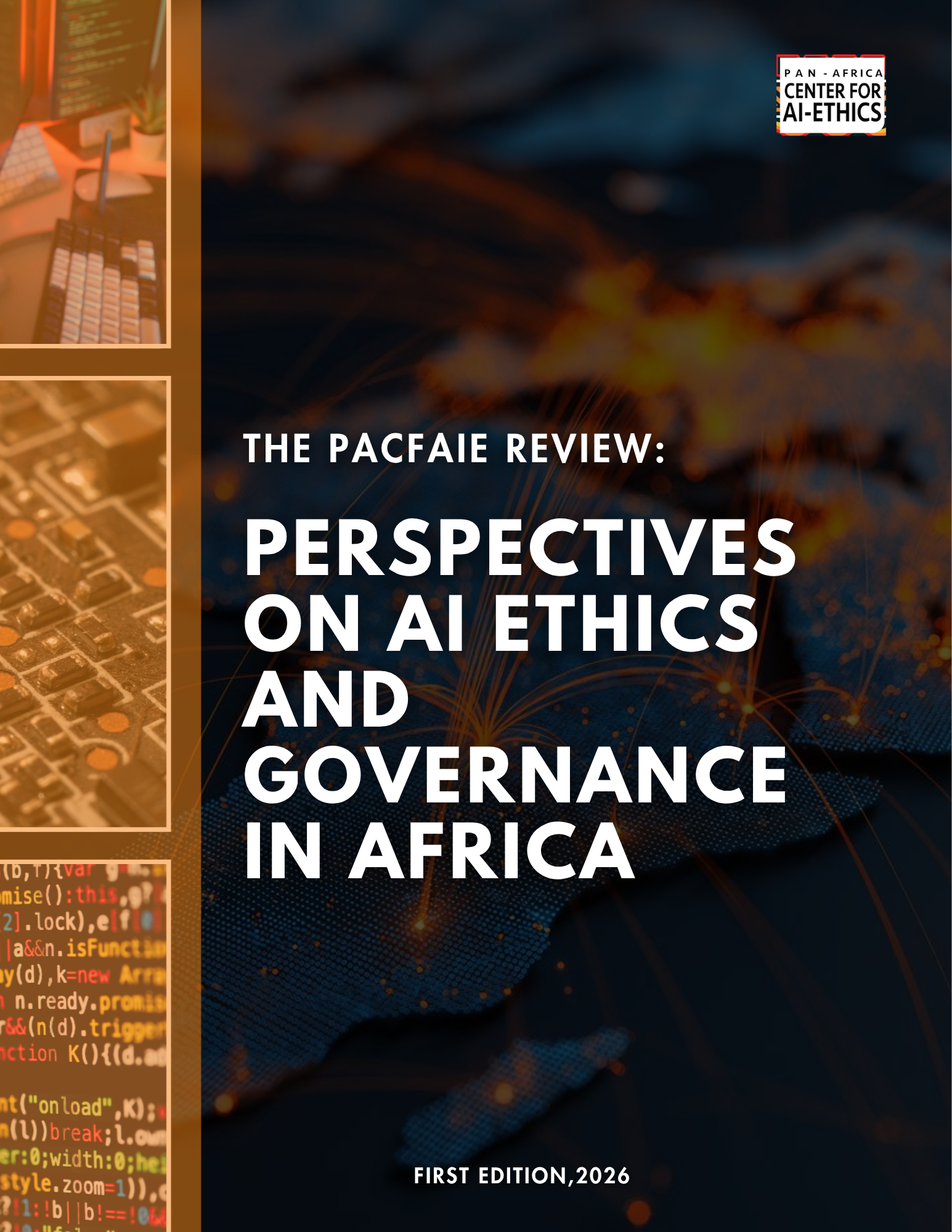
The PACFAIE Review cover
Linked publication

The PACFAIE Review

An annual publication on AI ethics and governance in Africa. Summer school participants are invited to contribute articles aligned with each edition's themes.

Learn more

Frequently asked questions

Do I need a background in AI?
No. What matters is genuine engagement with the issues — applicants do not need a formal AI or technical background.
What does it cost in total?
A $5 application fee at submission, plus a $20 program fee for accepted participants — $25 in total. Reduced program fees are available on request.
Are the sessions recorded?
Yes. All sessions and panels are held in English and recorded, so you can access them after each session.
Can I apply from the diaspora?
Yes. Applications are welcome from professionals, researchers and students across Africa and the diaspora.
Is the application fee refundable?
No, the $5 application fee is non-refundable.

References & further reading

  1. Global AI Summit on Africa 2025 — C4IR Rwanda
  2. Africa Declaration on Artificial Intelligence — AI Expo Africa
  3. France orders civil servants off Windows — The Next Web
  4. Trump administration defends Anthropic blacklisting — Al Jazeera
  5. Generative AI as a weapon of war in Iran — Brookings
  6. Iran's AI disinformation campaign — FDD
  7. Meta and the 2025 Israel–Iran war — Rest of World
  8. Cyber warfare in the US–Israel–Iran conflict — CSIS
  9. OECD AI Principles (2024) — OECD · UNESCO Recommendation (2021) — UNESCO
  10. AI governance gap between policy and practice — Thomson Reuters
  11. Do AI companies make good on commitments? — arXiv:2508.08345

Ready to apply?

Applications close 25 July 2026.

Start your application
Pan-Africa Center for AI Ethics

An African future for responsible artificial intelligence.

Follow

© 2026 Pan-Africa Center for AI Ethics. All rights reserved.
Pan-Africa Center For AI Ethics - Pacfaie
Privacy Overview

This website uses cookies so that we can provide you with the best user experience possible. Cookie information is stored in your browser and performs functions such as recognising you when you return to our website and helping our team to understand which sections of the website you find most interesting and useful.